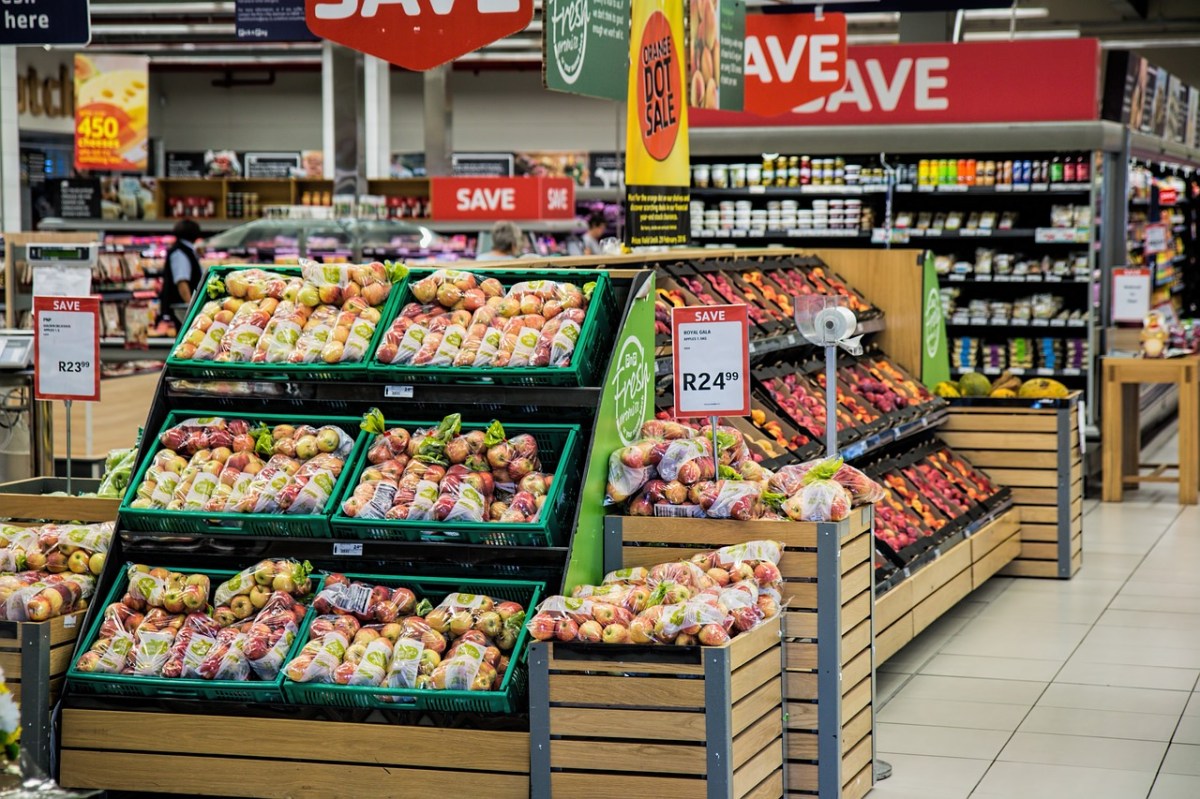
Supermarkets are, in a sense, large containers of an endless multitude of different types of goods. Among expensive caviar, bubbly champagne, and sugary popsicles, supermarkets hold the much more precious “essential goods”. For this very reason, supermarkets are one step ahead of any other shop: EVERYONE actually NEEDS to go there. Grocery stores have it easy on the “luring customers in” side, but still have to keep them in store and seduce them into spending more. This is ingeniously achieved through a series of well-thought strategies and tactics.
Walmart and Las Vegas’ Bellagio: twins separated at birth
Supermarkets, just like casinos, are designed to be disorientating, thus to increase the time we spend in them.
To begin with, it’s frequently difficult to find your way out of a grocery shop once you’ve entered it. One-way doors are a regular sight in supermarkets; to get out again, you have to walk through a significant chunk of the store, past all the enticing displays of items to buy (often featured in the same grid layout to encourage shoppers to walk up and down each aisle), just to finally locate an exit.
Furthermore, music is also used strategically to nudge consumers’ behavior. As a matter of fact, a famous study conducted in 1982 delved into the impact of background music on shoppers in supermarkets (Milliman, 1982). The findings revealed that when music was played, people tended to linger longer in the stores by a factor of 34%. This phenomenon is particularly interesting when taking into account that supermarkets, in general, lack external time cues, such as windows or easily accessible clocks, which could remind customers of the passing time. To further enhance the shopping experience and encourage prolonged stays in the supermarket, the deliberate separation of essential items from each other comes into play. For instance, everyday necessities like bread and milk are strategically dispersed throughout the store. By doing so, retailers aim to keep shoppers exploring the aisles.
Time is money, especially when talking about supermarkets. Paul Mullins and his research team at Bangor University in Wales conducted intriguing brain-scan experiments to understand how the continuous process of making decisions during shopping affects our cognitive abilities (www.bangor.ac.uk, n.d.). Their research showed that after approximately 40 minutes of shopping, most individuals reach a point where they find it challenging to make rational choices. Instead, they shift towards more emotional decision-making. It is at this juncture that around 50% of the items that were not part of their initial shopping intentions end up in their carts, leading to a remarkable increase in sales.
Eye contact – The Subtle Art of Supermarket Seduction
We usually tend to avoid eye contact so as to not end up in awkward situations; unless, of course, we are trying to seduce someone. Researchers described eye contact as a “non-verbal channel for communicating intentions, regulating interactions and expressing intimacy” (Binetti et al., 2016): supermarket displays represent this statement’s undeniable proof.
The arrangement of products on store shelves is a subtle but powerful psychological tool. Retailers employ various tactics to influence our choices. For instance, high-priced items often find their place conveniently at eye level, while lower-cost generic brands tend to occupy the lower shelves, requiring shoppers to stoop down to reach them.
Additionally, products designed to entice children are positioned at their eye level, a strategy that not only attracts young customers but also employs a clever design element. Research conducted at Cornell University revealed, indeed, that kid-oriented cereal packaging is intentionally crafted to have cartoon characters on the boxes make eye contact with children who pass by, creating a direct visual connection between the product and its target audience (Musicus et al., 2015).
Lastly, the psychological influence of product placement doesn’t stop at the shelves. Snack stands at checkout counters are an additional component of this retail strategy. These stands are strategically stocked with tempting snacks, often of smaller portion sizes, which can lead to impulse purchases as customers wait in line to check out. Interestingly, as part of Downing Street’s promised 2020 campaign against obesity, stands at checkouts, together with unhealthy snacks multibuy offers, were to be banned in supermarkets all over the UK starting April 2022. “Counter-nudging” consumer behavior, this government regulation would have toned down the negative consumption externality caused by unhealthy snacks and drinks. This plan has yet to be put into action, as it has been postponed to 2025 due to the ongoing living-costs crisis. Nonetheless, this still remains a great example of how behavioral economics is a powerful tool in the hands of both firms and the government.
Sources
Binetti, N., Harrison, C., Coutrot, A., Johnston, A. and Mareschal, I. (2016). Pupil dilation as an index of preferred mutual gaze duration. Royal Society Open Science, 3(7), p.160086. doi:https://doi.org/10.1098/rsos.160086.
Milliman, R.E. (1982) ‘Using Background Music to Affect the Behavior of Supermarket Shoppers’, Journal of Marketing, 46(3), pp. 86–91. doi:10.1177/002224298204600313.
http://www.bangor.ac.uk. (n.d.). Looking at how our brain assesses bargains | News and Events | Bangor University. [online] Available at: https://www.bangor.ac.uk/news/archive/looking-at-how-our-brain-assesses-bargains-17158 [Accessed 2 Nov. 2023].
Musicus, A., Tal, A., & Wansink, B. (2015). Eyes in the Aisles: Why Is Cap’n Crunch Looking Down at My Child? Environment and Behavior, 47(7), 715-733. https://doi.org/10.1177/0013916514528793.
 B.BIAS