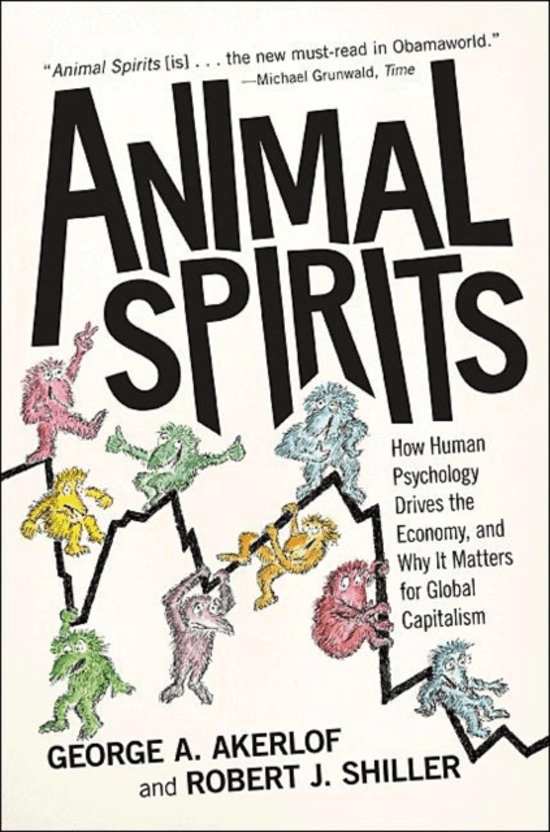
“Animal Spirits: How Human Psychology Drives the Economy, and Why It Matters for Global Capitalism” (2009) is a book written by George A. Akerlof, 2001 Economics Nobel Prize winner, and Robert J. Shiller, Economics professor at Yale. In the book, the authors examine the role of emotions and human psychology in shaping economic decisions and influencing market outcomes.
The term “animal spirits”, originally introduced by John Maynard Keynes in the 1930’s, refers to the impulses and human emotions that drive economic decision-making. Examples of such drivers include confidence, fear, trust, and pessimism. Akerlof and Shiller argue that traditional economic models often fail to consider the effects of these factors, as classic economic theory centers on the premise that people act rationally and, thus, make perfectly rational decisions. This is obviously not the case and can lead to incomplete understandings of real-world economic scenarios.
The first part of the book is centered around five examples of animal spirits: confidence, stories, corruption, fairness and money illusion. The authors first discuss how changes in confidence levels can impact investment decisions. When there are optimistic expectations for the future, businesses and investors are more likely to invest in innovation and expansion. Conversely, in periods of low confidence or high uncertainty, businesses can become hesitant to commit to large investments (this is also known as higher risk aversion), which hampers economic growth. Confidence is directly related to narratives, or the stories we are told about the economy, since the stories shared by the media, policymakers, and other prominent figures have the power to influence public perception and confidence, which can shape economic behavior and even policy outcomes.
Corruption scandals often play a role in determining the severity of economic recessions. Akerlof and Shiller give three examples of recessions in the US – the recession of 1990-91, the recession of 2001, and the one after the subprime crisis of 2007 – all related to corruption and bad faith, which led to the erosion of confidence. These examples illustrate how the business cycle is related to fluctuations in individual commitment to act in good faith and to fluctuations in predatory activity, which in turn are connected to changes in opportunities for such activities. Cultural changes can facilitate or hinder predatory activity, but since they fall outside of the realm of economics, they are rarely linked to economic changes.
Fairness is another animal spirit that has been generally ignored in economic thinking. Perception of fairness can influence people’s willingness to engage in economic activities, affecting wealth distribution and market dynamics. While there exists extensive literature on what is fair or unfair, such considerations often take a secondary place in the explanation of economic events. The same can be said about money illusion, which occurs when decisions are influenced by nominal monetary amounts. If people were rational, their decisions would only be influenced by relative costs and prices, not their nominal value. That is, macroeconomics assumes people can see through the effects of inflation. However, wage contracts, price setting, and bond contracts often fail to consider adjustments for inflation, which indicates the presence of money illusion to some extent.
Having offered evidence of the power of animal spirits, in the second part of the book Akerlof and Shiller give answers to some big questions about the functioning of the economy while putting emotions and human psychology at the forefront of their analysis. They defend the importance of understanding animal spirits when designing economic policies, calling for a holistic approach to policy making. They also advocate for measures aimed at inspiring confidence, mitigating speculative excesses, and fostering stability in financial markets.
“Animal spirits” is a thought-provoking and accessible book that traces a comprehensive analysis of how psychological factors can influence economic behavior. The authors bring real-world examples and compelling arguments throughout the chapters, making the reading engaging and easily digestible. However, some readers might point out that the book oversimplifies the complexities of economic behavior and lacks more details in the proposed policy solutions. Overall, “Animal spirits” is a worthwhile read for anyone interested in the field of behavioral economics or who would like to deepen their understanding of the intersections between psychology and economics.
 B.BIAS